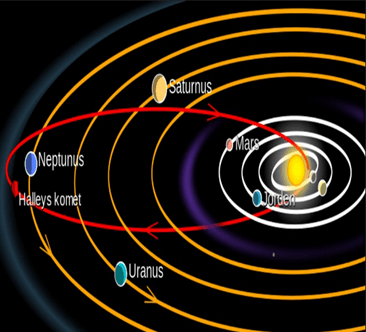
Comets (Greek: hairy stars) are the leftover debris from the formation of the solar system and contain mainly rocks, ice, water, ammonia, and methane. They are not stars. Based on Newton’s theories of gravitation and planetary motions, in 1682, Englishman Edmund Halley (1656-1742) made a mention of three comets that appeared in 1531*, 1607 and 1682, and that these three must be a single comet, which returns periodically. He correctly predicted the comet would return in 1758. Each time it returns to the inner solar system its nucleus sprays ice and rock. This debris produce two weak meteor showers each year. While passing close to the Sun, some of its ice sublimate and produce a stream similar to a hairy tail.
Period of a complete rotation of this comet around the Sun and the planets varies from 74 to 79 years, because of the variable gravitational effects of the planets on it. But generally, it is about 76 years. Its orbital trajectory is elliptical and lies in a plane tilted 18 degrees to the orbit of the Earth.
Dimensions of this comet are about 9 by 5 miles. It is one of the darkest, or least reflective, objects in the solar system. It reflects only 3% of the light that falls on it. Its travel is said to be retrograde, that is, it moves backward (opposite to the direction of Earth’s motion) around the Sun.
Lifetime of a comet decreases with each orbit. Halley’s comet loses 3 to 10 feet of material from its surface. As the comet ages, it dims in appearance and may lose all the ices in its nucleus. The tails may then disappear, and the comet may change into a dark rocky mass or perhaps dissipate into dust. Most comets live to complete about 1,000 trips around the Sun.
Since February 9, 1986, when Halley’s comet was at the perihelion (closest to the Sun) last time, it began its journey back, moving away from the Sun, and has now arrived at the aphelion (far end of its orbit). This position (on December 8, 2023) is about 3.3 billion miles away, and beyond the orbit of Neptune. Its speed would come down to about 2,034 miles per hour, from 121,572 miles per hour at perihelion in 1986. (As per Kepler’s Law : fastest at perihelion and slowest at aphelion.)
Brightness of a comet depends mainly upon its distance from the Earth. The view of Halley’s comet in 2061 may become dim or may be obliterated also if the amount of light pollution in the atmosphere is very high, and the weather is unfavorable. In February 1986, this comet was very faint, being on the opposite side of the Sun in mid-winter; but in mid-summer of June 2061, the comet will be on the same side of the Sun as us, in full view, and appearing at least 10 times brighter. In 2061, it will be approaching the Sun and Earth with increasing speed, and so it will appear brighter. (Perhaps, some of the older people amongst us may not be able to see it).
The Astronomical Unit (A.U.), used for very large distances, is the mean distance of the Earth from the Sun (about 93 million miles). In May 2041, Halley’s Comet will be at a mean distance of 30.6 A.U. It will cross Earth’s orbit on June 19, 2061, and will arrive at the perihelion on July 28, 2061, at a distance of 0.15 A.U., or about 14 million miles, closer than the distance during its last visit in 1986. It will be bright, and would have a white dust tail. As this comet recedes from the Sun and Earth, its lustre will wane.
Scientific studies of this comet have been conducted by five spacecrafts (called Halley Armada); two sent by Japan, two by the Soviet Union and one by European Space Agency (ESA). Also, NASA’s Pioneer (7 and 12) have made significant contributions to the data collected. Among other parameters, they studied its structure and measured solar wind and the charged particles, the size and chemistry of these particles and examined the emissivity of the surface.
Formation of Comets : When the solar system formed from clouds of interstellar ionized atoms, having random velocities. The charged particles attracted one another, collided and finally collected into clumps. Their velocities averaged out into disks and formed Suns, planets and their moons. The left-over pieces formed the asteroids and the comets. Between Mars and Jupiter, we have an asteroid belt. The asteroids have highly elliptical orbits and some of these objects become comets when they head towards the Sun and cross into a cold region called “Frost Line”. This is the minimum distance from the central star where the temperature is low enough for the volatile compounds, such as water, ammonia, methane, carbon monoxide and carbon dioxide to condense into solid grains, allowing their accretion. Beyond this line, the gaseous compounds are condensed to ice giants; while within it, only heavier compounds can be accreted to form rocky planets. The current Frost Line distance is nearly 5 A.U. The ice got buried in dust and it has remained stable a few meters below the surface of the comet.
*Note: Guru Nanak (1469-1539) had written about an “elongated star” (in Sri Guru Granth Sahib, Page -1110), probably for this comet when it appeared in 1531. He used the word ‘star’ prevailing then to address the people as this word was used by the common people at that time for all bright celestial bodies. The early telescopes were invented around 1608.

 Dr. SS Bhatti