Plastic items have become essential parts of our daily life today. Plastic is used so commonly because it is more versatile than any other material. It offers flexibility in color, strength, shape, weight, and durability. It has numerous uses in most consumer and industrial goods. It offers important hygiene applications through disposable surgical gloves and face masks, or as packaging to protect food and medical supplies from contamination. It’s also used to improve safety, in everything from bicycle helmets to electrical insulation.
The problem of toxic plastic waste
World’s projected non-biodegradable toxic plastic waste in landfills and the environment by 2050 is about 12,000 Megatons. It can survive for hundreds of years and presents one of the gravest threats facing the Earth, particularly to biodiversity. Plastics account for nearly 85% of marine pollution, with about 200 million tons in the ocean. Its production is twice as much now as two decades ago. Of the 15 % of waste collected in the world, hardly 10 % is recycled. A large part of it is either not collected or burnt. It blocks up natural waterways, polluting the water and disrupting the flow of rivers. This contributes to flooding and also provides havens for mosquitoes and diseases.
It also contributes to Climate Change as the open burning and the solid waste in dumps and landfills account for about 10 % of total global greenhouse gases (GHG). This will result in a 4-fold increase in global emission of GHG by 2050. The UN and OECD (Organization for Economic Co-operation and Development) are, therefore, making efforts to reduce soil and water plastic pollution. Research is focusing on novel plastics, manufacturing processes, and more degradable plastics.
Why do we depend so much on plastic goods?
Virgin plastic is cheap and easily available. It is cheap, as it is produced by the subsidized fossil fuel industry. The International Energy Agency estimated that it will boost up (by another 50%) the oil demand, by 2050. Making new plastic items is cheaper than collecting and recycling waste items. The emission of GHG is low during manufacturing goods using new plastics but more in the processes for items made from glass, steel, alloys, and aluminum. Some plastics (called thermoplastics) can be melted and molded to produce new plastics which (theoretically) are recyclable. The others (called thermosets), do not soften when heated, making recycling impossible.
Plastic Production Rate and Waste Rise Every year!
Plastic production was about 2.5 million tons in 1950. It rose to about 500 million tons by 2020. It is about 10 billion tons now and will be about 50 billion tons by 2050. The US (with 4% of the world’s population) annually produces close to 20 % of the world’s plastic waste, about 220 kg per person. For European OECD countries, plastic wastes are nearly half of the US figures. Canadians discard over 3 million tons of plastic waste every year. Only about 9 % is recycled while the rest ends up in landfills, waste-to-energy facilities, or the environment.
Production of plastic goods all over the world far exceeds collecting trash for recycling. Greenpeace (An independent global network) found that the more plastic is reused the more toxic it becomes. Qutab Minar is 72.5 m high but the Delhi waste matter dump, mostly plastic, was already 64.5 m high in 2022 and is growing steadily. Recycling all the plastic that is dumped in landfills is practically impossible and the problem is getting worse.
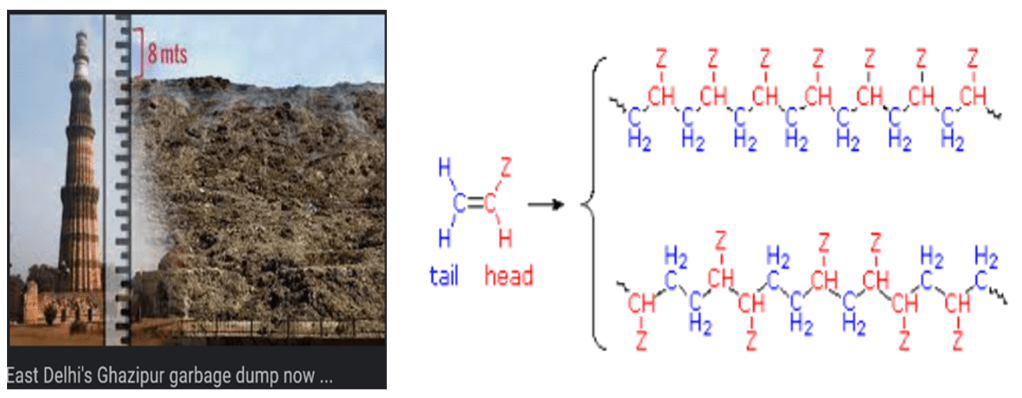
Why is Synthetic Plastic Long Lasting?
The natural resin required for plastics is obtained from trees and its processing uses fossil oils. Resin has strong Carbon-Carbon (C-C) and Carbon-Hydrogen (C-H) chains (or polymers). Common polymers used for making plastic include PVC (Polyvinyl chloride), BPA (bisphenol A), LDPE (low-density polyethylene), HDPE (high-density polyethylene), and PET (Polyethylene terephthalate). Polymers can be spun in cotton for silky fibers. Plastics are inert, insoluble in water, and generally do not react to common chemicals. They do not rust or leach into the water.
Chemical pigments, heat stabilizers, and flame retardants, mostly toxic, are added to make them stronger and long-lasting. Recycling involves shredding the waste plastic materials into flakes and melting them to get low-grade plastic and fuel oil or Diesel. These are used for the manufacture of water and oil pipes and many other cheap disposable items. Many companies have invested in expanding the capacity for plastics recycling, a potential sign that they expect greater demand.
Plastic Containers – A Serious Health Hazard
Plastics contaminate human and animal food chains. Adverse hormone disruptions may take place in some cases and some diseases may originate or get worse. Synthetic polymers smaller than 5 mm in diameter (called microplastics) act as pathogenic hubs and are ingested by infants in plastic bottles. These bottles are heated to sterilize them and prepare formula milk. Lunch boxes and water bottles likewise harm the users.
Plastic Waste Problem for Marine Life
Kitchen waste, like millions of plastic plates, cups, liquor/ water/ milk/ juice bottles, and straws are discarded daily on beaches, lakes, rivers, and seas. The entanglement of sea animals with these items and the ingestion of poisonous chemicals in plastics are quite common. Starvation due to choking is another reason for the destruction of more than 700 species of marine life. Plastic contaminants are found to be about 7-to-1 times more than baby fish in Larva nurseries. Wayward fishing gear and plastics in ships’ wreckage debris kill many types of small fish. Big fish mistakenly eat plastic scraps as small fish. About 10 million sea animals and fish are killed every year in these processes. Chemical deposits in animal bodies reach sea foods for humans. These deposits also create an artificial plastic sea floor.
Earth Day (April 22) every year recommends “No Plastics“
“Alliance of Industries to End Plastic Pollution”, with 50 major global companies as its members, has invested over one billion dollars to develop and deploy solutions to minimize plastic waste. Also, Multiple-use items are favored to replace Single-use plastic items. Paper or cloth packing and carry bags are being popularized. Substitutes are being developed for plastic items like Instruments in hospitals and textiles, furniture, kitchen cutlery, sports goods, road tires, air transport devices, building materials, items used in construction work, and electrical Industries. Paper and polylactic acid (PLA) are currently the two most popular alternatives to single-use plastics. However, these are biodegradable only in industrial composting plants that are greenhouse gas (GHG) emitters.
University of Delaware (USA) discovered Hydrocracking at 3000 C that breaks plastic waste into gases for jet fuels, Diesel oil, and lubricants.
Lawrence Berkley National Laboratory (USA) has found new plastics, that are recyclable repeatedly without any loss of quality, and comparatively more biodegradable if no additive is used.
Self-destroying plastics from compostable enzymes have been discovered. These enzymes eat the plastics and reduce them to lactic acid that feeds the soil microbes in the compost. This makes it more biodegradable.
Turning waste into nanotubes of Hydrogen and Carbon improves their electrical and thermal conductivity. These are the sources of H-fuel to replace fossil fuels and are also used in making auto parts, filters, and energy-saving devices.
Plastic films, mimicking the non-toxic spider silk, are being prepared from wasted food proteins and textile fibers, for use in Cosmetics and Agricultural Sprays by BASF (Badische Ailin and Soda Fabrik), a Canadian Chemicals Company.
Bacteria from Cows’ stomachs are being employed (in Austria) to soften plastics, making them easily degradable, and are used in making plastic bags.
Current Research is also directed to find how to obtain degradable plastics from the extraction and refining of fossil inputs, in addition to mechanical recycling and molecular technologies using disposed plastics inputs.
World’s Future without plastic is neither realistic nor desirable. Plastic is very useful and will remain with us in the future. In fact, it has moved from the eighth to sixth largest U.S. manufacturing industry. The sector accounted for nearly one million jobs and $468 billion in shipments in 2021. However, plastic waste is also very expensive to manage. The estimated global cost of waste management runs into billions and is set to double in the next two decades. Many developed countries are exporting this waste to developing countries, which is an unsound practice. Earlier, China was a preferred destination, but since 2017, she restricted the import of low-quality plastics. The export of plastic waste is now been directed to other underdeveloped countries. The world should aim for a future of drastically reduced plastic consumption and eliminating plastic pollution.
In February 2022, the UN Environment Assembly met in Nairobi, Kenya, and agreed to implement a set of resolutions to stop the global plastic pollution crisis. This treaty might help countries coordinate their plastic waste policies.

 Dr. SS Bhatti