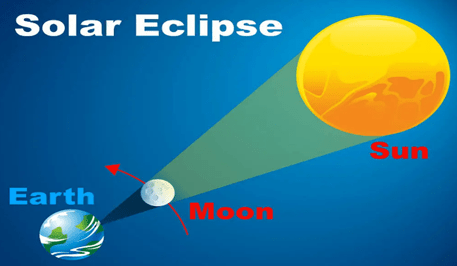
Solar eclipses occur when the Moon passes between the Sun and the Earth. Moon’s orbit is inclined at an angle to the Earth’s (Elliptic) path around the Sun. Hence, the Moon usually passes above or below the Sun as seen from the Earth and thus there is no eclipse every time. The proper alignment for a solar eclipse occurs only a few times a year.
A Total Solar Eclipse occurs when the New Moon fully blocks the Sun from our view. There is complete darkness and one can see the stars during the day. The Moon is surrounded by some solar flares from the Sun’s outer edge called corona.
Annular Solar Eclipse takes place when the Moon is at its farthest point (apogee) from the Earth. The Moon in this position appears smaller than the Sun. Hence, it does not completely cover the Sun during the eclipse, and the darkness, therefore, is not complete. The solar disc appears only as a bright ring (annulus).
A partial Solar Eclipse happens when the Sun, Moon, and Earth are not perfectly lined up. A crescent- Sun is visible while the rest is covered. During a Total or Annular Solar Eclipse, outside the Moon’s inner shadow, a partial eclipse is visible.
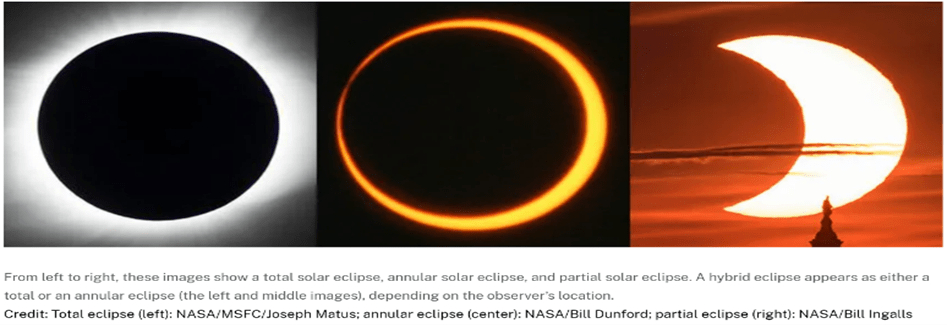
Hybrid Solar Eclipses are observed sometimes when shadows shift between Annular at some points on their path and Total at other points, as the Moon moves across (the curved surface of) the globe.
The path of an eclipse begins when the Moon touches one edge of the Sun and it ends when the Moon leaves the opposite edge of the Sun. Shadow of the Moon in the October 14, 2023, Eclipse follows a curved path from Africa, North America, South America, the Pacific, Atlantic, and the Arctic, and then moves on to the East.
The duration of visibility varies according to the location of the place. The curvature of the Moon’s path is due to the Earth’s rotation, its point of view moving around the Earth at a speed greater than that of Earth’s normal rotation.
The Coordinated Universal Time (UTC) when this eclipse begins is 15:03:50, while it ends at 20:55:16. In Canada, it starts at 8.07 a.m. Pacific Daylight Time (PDT) and ends at 3.32 Atlantic Daylight Time (ADT). For Calgary, its duration is from 9-14 a.m. to 11- 45 a.m. Mountain Daylight Time (MDT). The Next Annular Solar Eclipse will be on October 2, 2024.
Precaution: One should never look directly at solar eclipses without special ‘Eclipse Glasses’. Observing through a camera viewfinder, binoculars or telescope can cause permanent damage to the retina. A Solar Filter for the camera and a Telephoto Zoom Lens are required for photography.

 Dr. SS Bhatti